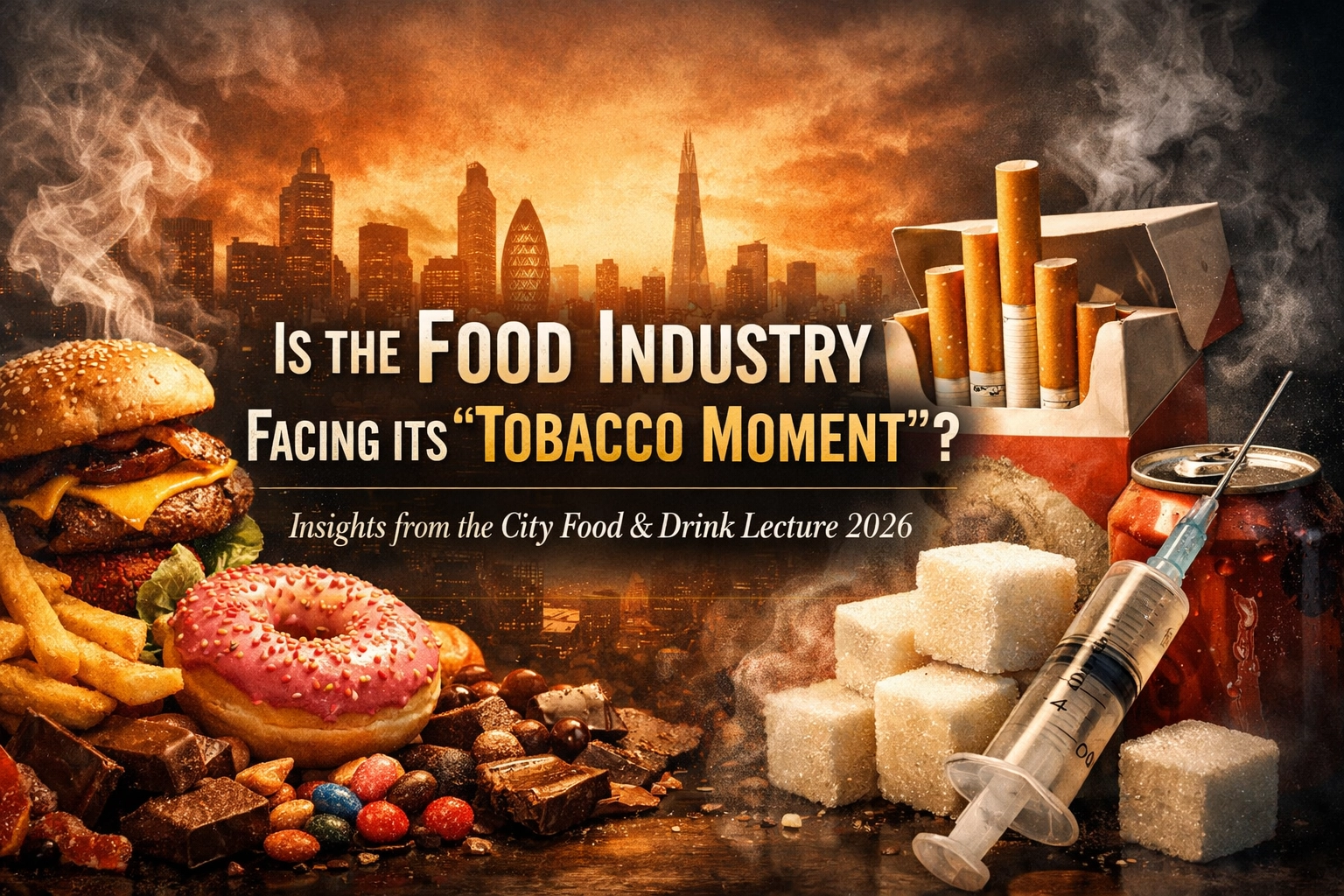
- Where: The historic Guildhall, London
- Occasion: The 25th anniversary of the City Food & Drink Lecture
- Speaker: Professor Susan Jebb OBE
- Vibe: Not a celebration. A reckoning.
Professor Jebb's message was sobering, clear, and impossible to ignore:
- The last 75-year mission is over: feeding a hungry nation with cheap, convenient calories
- The new mission is here: a fundamental Food System Reset
- If we don’t lead it, someone else will force it on us
The "Tobacco Moment" Has Arrived
The phrase "Tobacco Moment" isn't hyperbole, it's already playing out in courtrooms and policy chambers.
- In San Francisco, 10 major food manufacturers (including Kraft Heinz, PepsiCo, Coca-Cola, and Nestlé) are facing a lawsuit accusing them of using "deceitful tactics inherited from the Big Tobacco industry."
- The allegation: companies knowingly flooded the market with harmful ultra-processed foods and marketed them to children.
And yes, the history is messy:
- In the 1980s and 1990s, tobacco giants like Philip Morris and R.J. Reynolds owned major food corporations (Kraft, General Foods, Nabisco).
- Internal documents showed tobacco scientists transferred know-how on making products irresistible into food.
- Research shows products owned by tobacco companies were 29% more likely to combine addictive levels of fat and sodium [5].
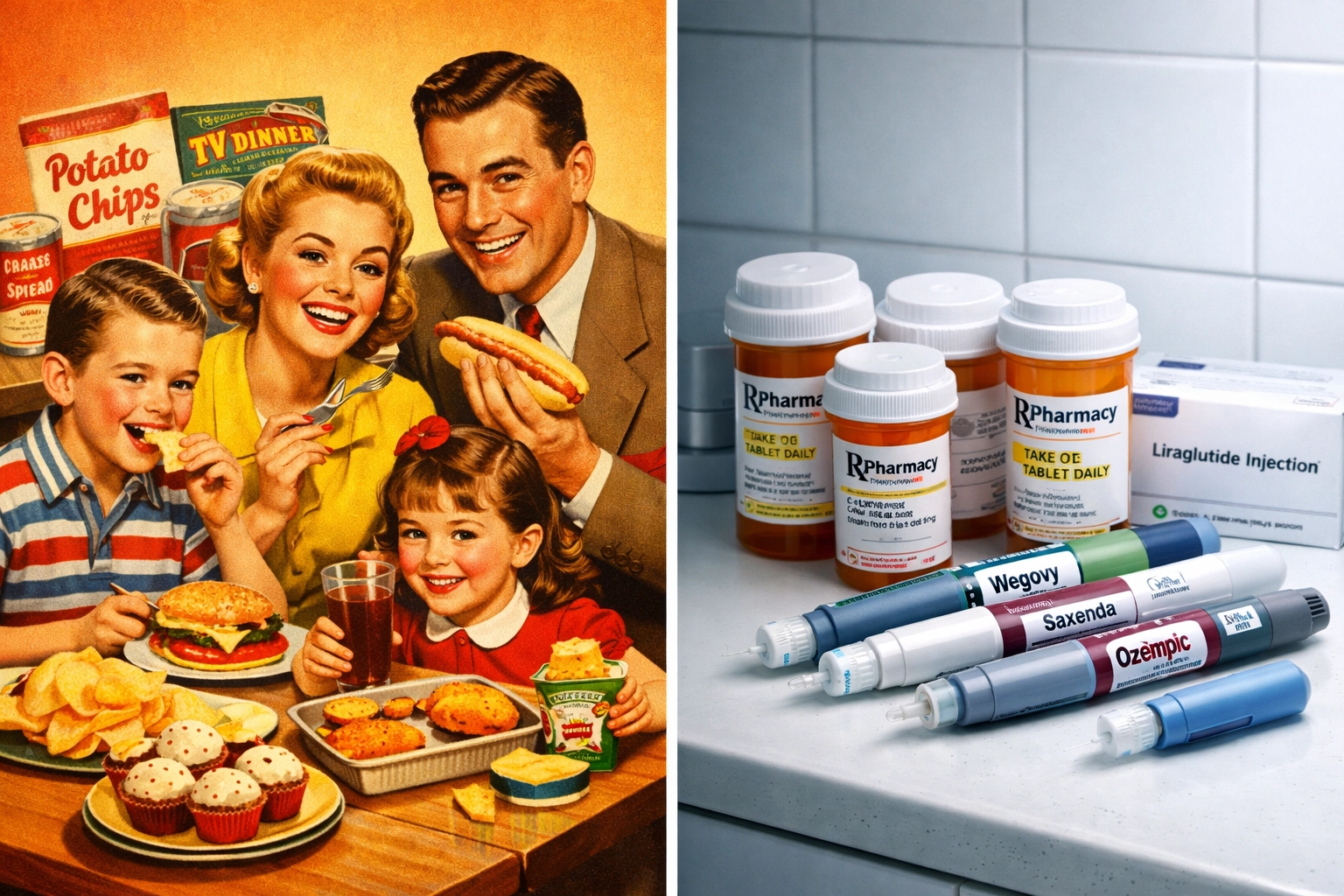
The parallels are uncomfortable, but they're real. And the UK isn't immune. We've already introduced restrictions on pre-9pm junk food advertising. The question isn't if regulation is coming, it's how quickly, and whether we'll be ready.
The Stats That Should Keep Us Up at Night
Professor Jebb didn't pull punches with the data:
- 1 in 10 children are obese by the time they start primary school.
- 1 in 5 have tooth decay.
- £268 billion per year [1]. That's what the UK's addiction to unhealthy food costs us annually in health and welfare spending, plus lost productivity.
Let me repeat that: £268 billion. Not million. Billion.
This is:
- A health crisis
- An economic crisis
- A national resilience / security issue (a population that’s unwell is less able to withstand shocks)
And honestly, the hardest part to sit with:
We did this. Our industry did this.
We got brilliant at cheap + convenient
Somewhere along the way, "feeding" became "fuelling disease"
The Three Shocks Every Food Leader Must Prepare For
Professor Jebb outlined three systemic disruptions already reshaping our industry.
If you're a UK manufacturer still operating on 2020 business models, buckle up.
1. The GLP-1 Effect: When Volume Disappears
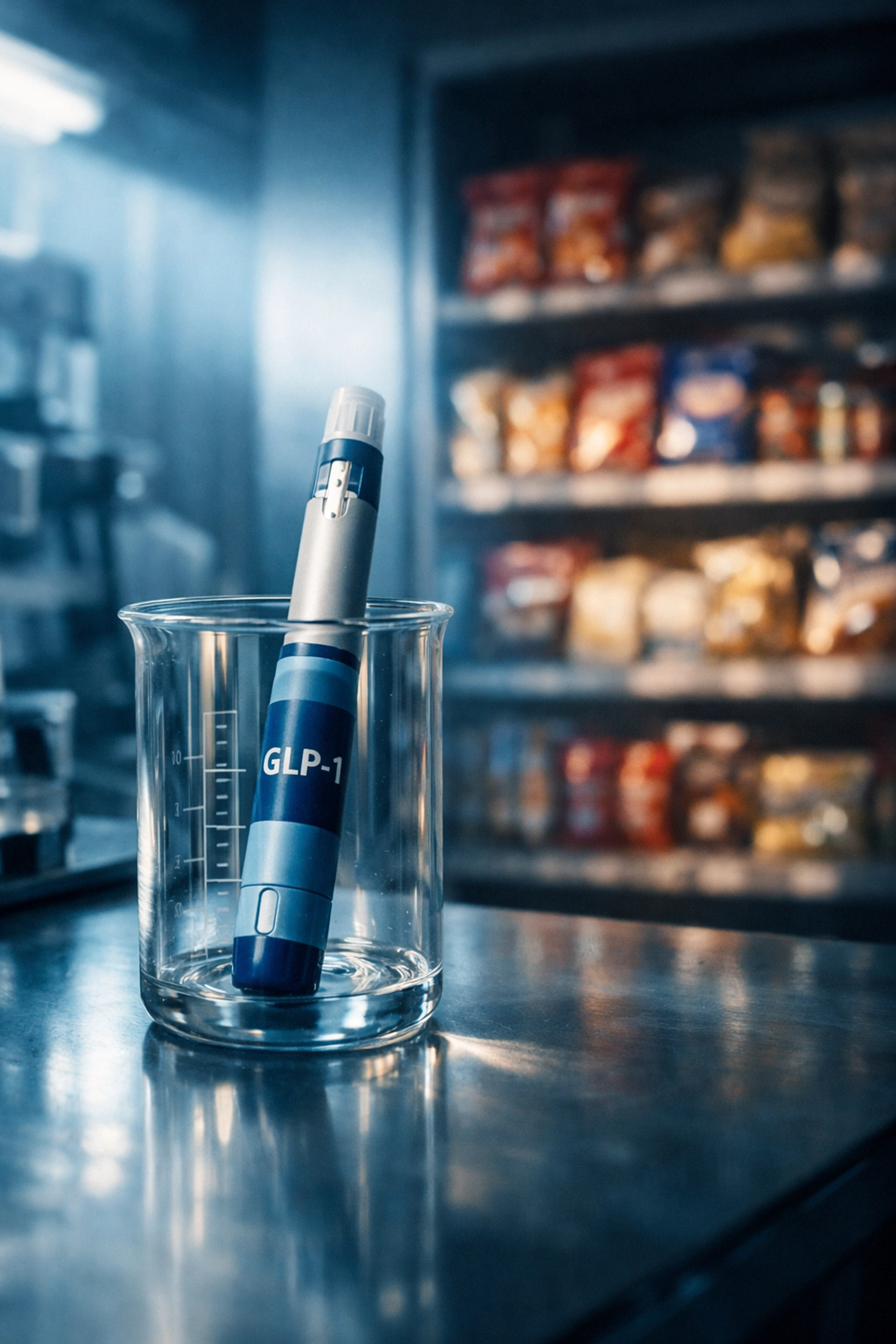
Weight loss medications (GLP-1s like Ozempic and Wegovy) are already being used by 2 million Britons [2], and that number is set to skyrocket.
Why it matters: GLP-1s don’t just reduce weight, they reduce "food noise" (cravings + impulse urges).
Key implications:
- Potential 26% drop in energy intake per person among users [3]
- When cravings reduce, the first things to go are often:
- hyper-palatable snacks
- impulse confectionery
- high-volume processed foods
The uncomfortable question for the industry:
We’ve built business models on volume ("just one more", the 3pm sugar crash)
What happens when the impulse disappears?
What wins instead:
- Nutritional Density becomes the battleground
- If people eat fewer calories, every calorie has to count (protein, fibre, micronutrients)
2. Ultra-Processed Systems, Not Just Ingredients
The UPF (ultra-processed food) debate has been stuck in a loop of definitions and ingredient lists. Professor Jebb reframed it brilliantly:
- It’s not just about what’s in the product
- It’s about the system that requires long shelf-lives and global supply chains
Ultra-processing isn’t inherently evil, it’s a solution to a real problem: feeding millions of people affordably with products that can sit on shelves for months.
But the consumer mood has shifted:
- 79% of UK consumers are actively trying to reduce their UPF intake [4]
- They’re reading labels
- They’re choosing "real" over "weird"
And they’re not wrong to be suspicious:
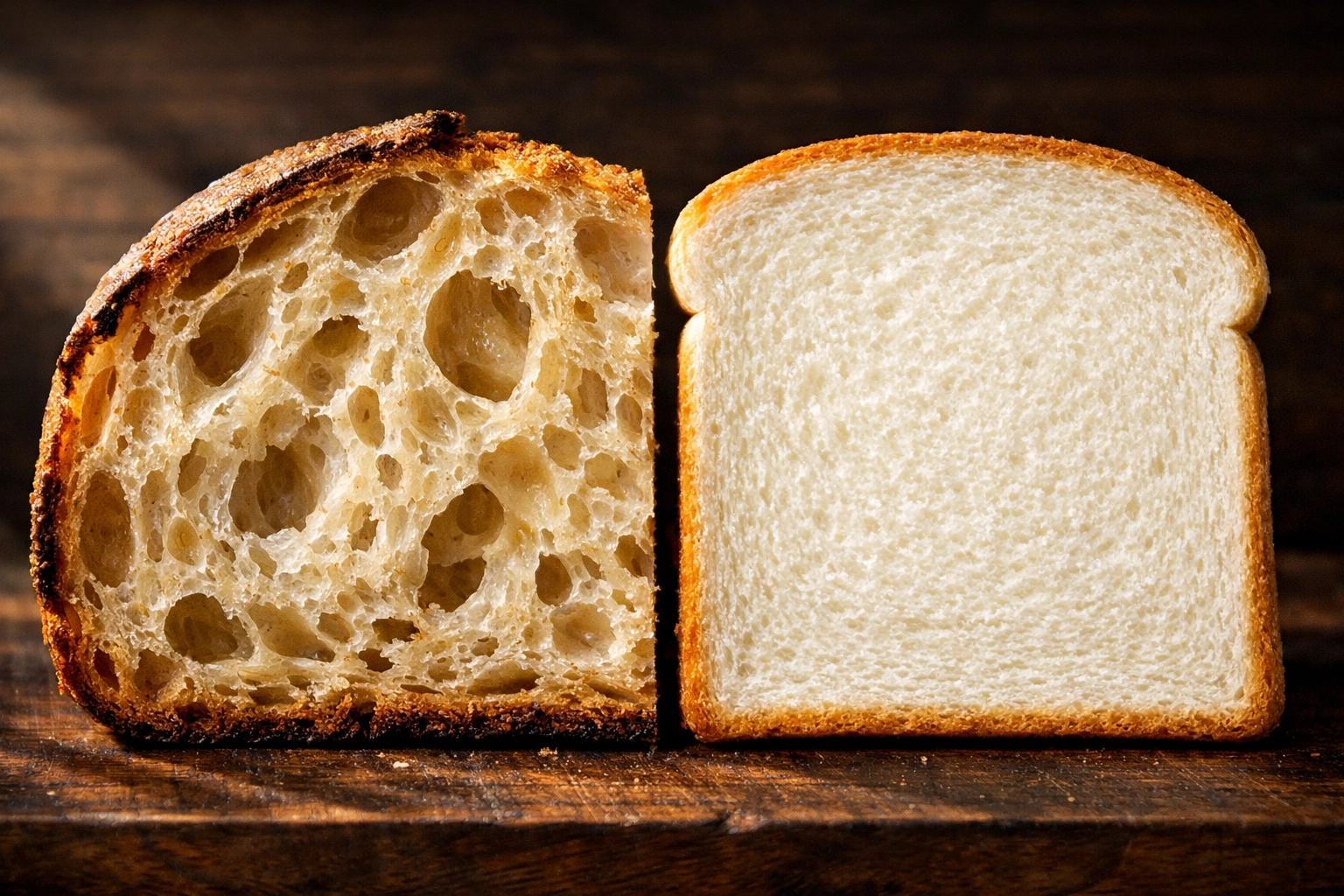
- If you need 47 ingredients to make bread last 14 days, you’ve moved beyond "food" and into "food product"
- The industry response so far has often been:
- defensive
- lobbying against UPF labelling
- arguing about definitions
- reformulating around the edges (sound familiar, tobacco industry?)
But what if we led with honesty instead?
What if we admitted that yes, some of our products are designed for shelf-life over nourishment, and we're committed to changing that? Radical transparency beats defensive denials every time.
3. The Food Data Revolution
Here’s where it gets operational. Professor Jebb called for an integrated data infrastructure from farm gate to final product.
Because:
- We can’t fix what we don’t measure
- Current systems are often fragmented, proprietary, and focused on cost optimisation, not health outcomes
What this could look like:
- Track and access each ingredient’s:
- nutritional profile
- environmental footprint
- supply chain transparency
- Segment consumers by actual health needs, not just demographics
- Prove (with data) that reformulation is delivering real impact
Bottom line:
- This isn’t a fantasy. The tech exists.
- What’s missing is the industry-wide commitment to stop resisting transparency and start leading with data.
At Seeds to Thrive, this is exactly the kind of systemic work we’re focused on: helping businesses measure, track, and communicate real impact (not just market intentions).
What This Means for UK Manufacturers
Let me be blunt:
- The "old way" (chasing volume through hyper-palatability + long shelf-life) is becoming a business risk
And it’s not because consumers are perfect (they’re not). It’s because:
- Regulation is tightening
- Investor sentiment is shifting
- The reputational cost of being "the next tobacco" is existential
The good news:
- The food industry isn’t going anywhere
- We’ll still need roughly 2,000 calories a day
- But the type of calories we provide is about to change forever
Who thrives next:
- Pivot to Nutritional Density (stop fighting to maintain volume)
- Lead with transparency (stop lobbying against it)
- Invest in real reformulation (not marketing workarounds)
- Collaborate with regulators (rather than opposing them)
- Use data to prove impact (not just to optimise profits)
The question Professor Jebb left us with was deceptively simple:
The industry has been incredibly creative at feeding us. Now, can we be creative enough to heal us?
The Challenge Ahead
As I left the Guildhall and walked back through the City, I kept thinking about Eglantyne Jebb, the founder of Save the Children and Professor Jebb's relative. In 1921, facing the aftermath of World War I and widespread child malnutrition, she said:
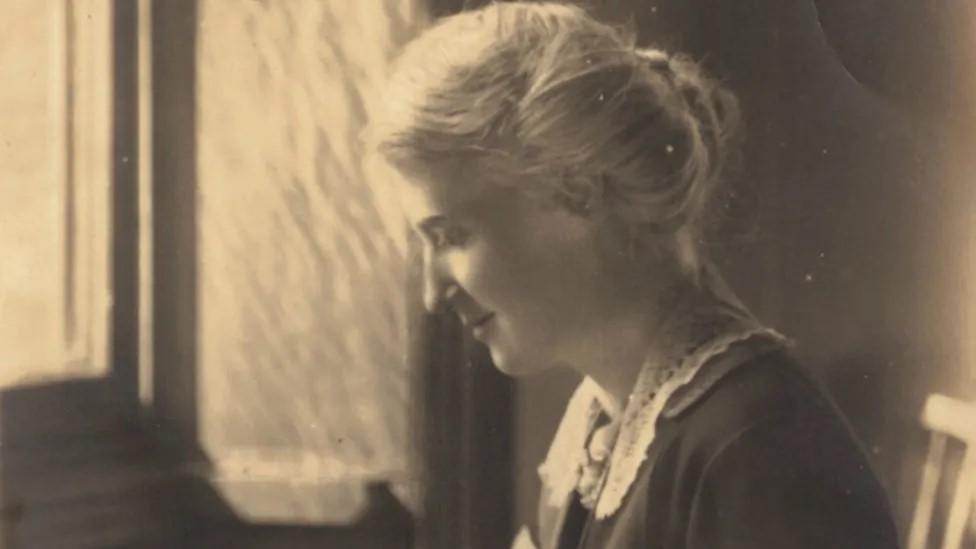 "It's impossible only if we make it so. It's impossible only if we refuse to attempt."
In 1921, Eglantyne was fighting to save children from starvation. In 2026, her namesake is fighting a different kind of malnutrition: one caused by abundance, not scarcity. But the challenge is the same:
Are we brave enough to attempt the impossible?
We don't need more strategies that sit on shelves gathering dust. We don't need another "industry commitment" with no teeth. We need a fundamental reset of what we offer and how we deliver it. We need to stop saying "it's too expensive" or "consumers won't buy it" or "the margins don't work" and start asking: What if we refused to make it impossible?
Because the alternative: doing nothing, defending the status quo, waiting for regulation to force our hand: isn't just bad business. It's a betrayal of the very mission that built this industry in the first place: to nourish people, not just feed them.
I'd love to hear from my network:
Were you at the lecture?
What was your "penny-drop" moment?
And for those who weren't there: what's the "impossible" challenge in your business that maybe, just maybe, is worth attempting?
What’s your take on this shift?
Let’s start the conversation.
Sources & Further Reading
- FFCC — The Hidden Cost of UK Food: £268 Billion Report (for the £268bn estimate): https://ffcc.co.uk/
- “GLP-1s in the UK: 2026 Market Adoption Report” (for the 2 million GLP-1 users projected adoption figure): https://example.com/glp-1-uk-2026-adoption-report
- Morgan Stanley Research — The Impact of GLP-1s on Food Consumption (for the 26% intake drop estimate): https://www.morganstanley.com/
- Soil Association / YouGov — UK Consumer Attitudes to Ultra-Processed Foods (for the 79% UPF consumer sentiment): https://www.soilassociation.org/
- Tera Fazzino et al. — “The Tobacco-Food Connection: Hyper-Palatability and Corporate Ownership” (Addiction / Wiley Online Library) (for the 29% tobacco-owned hyper-palatability stat): https://onlinelibrary.wiley.com/
- NHS Digital — National Child Measurement Programme (NCMP) 2025/26 (background context for child health metrics referenced): https://digital.nhs.uk/